12. That wouldn't have been any fun!
Warm-up
The end of my school year required a lot of RAM and not enough resets, so I haven’t posted in a while. Given that, I’ll start with some warm-up questions.
Why is consciously using DSRP important?
I could respond to this question in many ways, and yet one feels especially relevant. That response is: A person cannot really understand their own, or anther person’s thinking precisely without mapping the various points on a view that people use while taking perspectives. In some instances we are fine doing this implicitly, but pushing the ability into our explicit awareness and control is game changing. As for practicing DSRP in general, precise perspective-taking requires using the other three patterns skillfully. (Actually, each other pattern requires the other three).
Why is being skillful at perspective taking so challenging?
Because generally, people talk as if there is only one perspective way too often. Some people consistently adjust their internal interpretation of talk because they have a sense of the multi-perspective nature of reality. Other people are conditioned by their experiences in discussions and interactions into thinking that there really is only one perspective. This does’t happen to 100% of their thinking, but it happens to enough, and they are unable to distinguish when it is happening and when it is not. And this conditioned response to language can have a strong negative effect on a person’s ability to align their mental models with reality.
I’m not speaking about the single perspective problem theoretically. I know firsthand what an implicit and dominant single perspective thought process looks like, and the resulting havoc it led to in my life. My reflections on this blog are an attempt to: 1. Add complex perspective taking practice to my routine so that I slip back into single perspective thinking less and less and 2. Share the practice so that others have more resources if they choose to do the same.
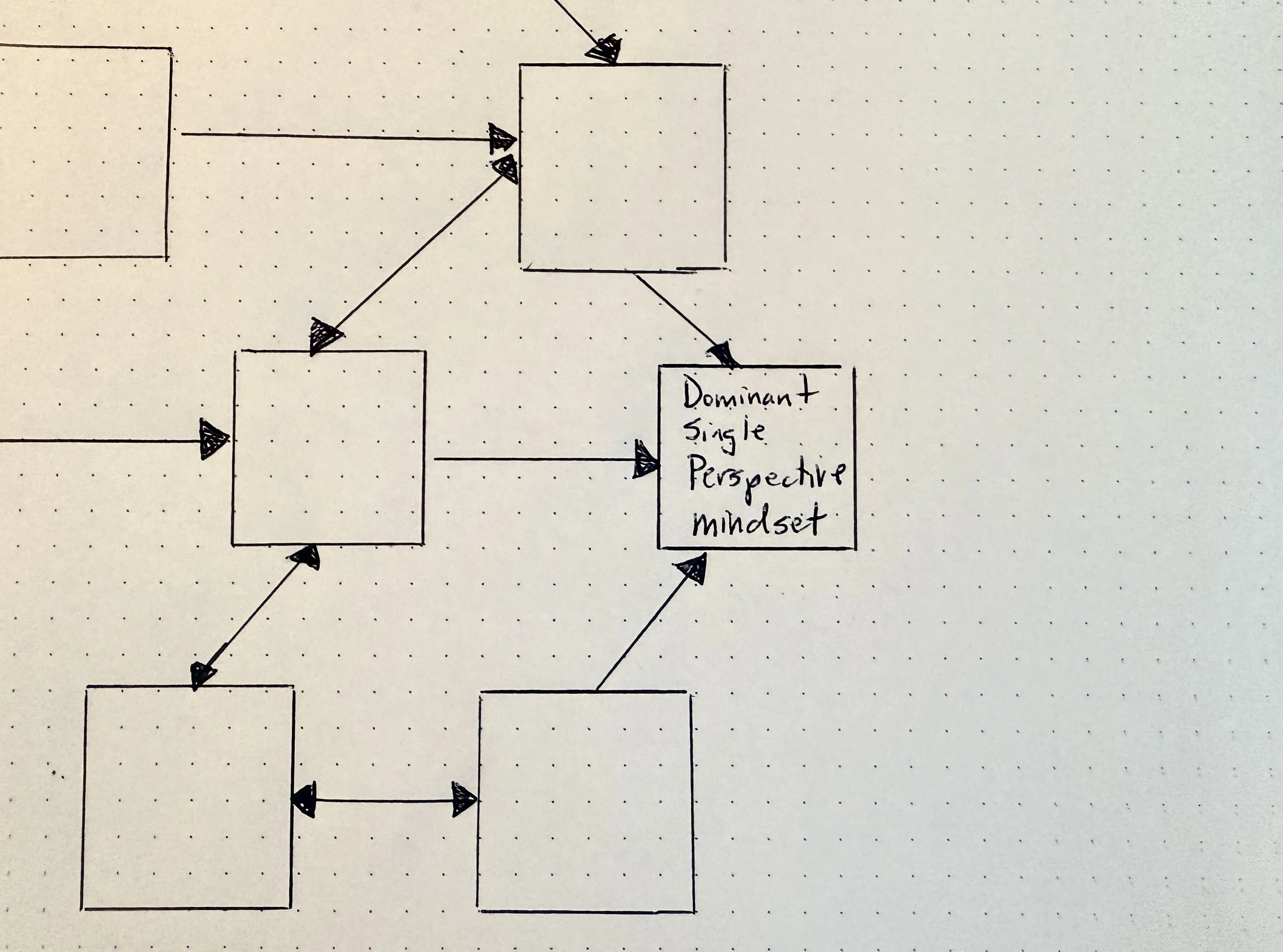
Warm-up Map. A causal web (map) of the factors that contribute to a people adopting a default single perspective mindset. In the text I’ve only identified one part of a complex web. A dominant single perspective mindset is an action that leads to complex reactions too…
Is DSRP the only tool needed?
I’d say prioritizing time for meditation, mindfulness, reflection and building explicit collaborative infrastructure are also super beneficial.
How often am I explicitly using DSRP?
That depends. I am generally oscillating back and forth between three mental points. 1. Unaware and acting based on the habits my experiences have conditioned into me (highest frequency). 2. Consciously updating my mental models using DSRP in real time or reflectively modeling and updating thoughts spurred by something that just happened. 3. Trying to simply be as open and aware as possible. The more I am concerned about my mental model accuracy or the unreliability of my conditioned responses to experience (which in many areas is a lot), the more effort I spend consciously modeling my thinking and the thinking of others. I am best able to simply be open and aware when I am working with students.
How does Post 12 connect to the last post?
In my last post I talked about inferring a person’s conceptual point on a view to understand that person’s perspective. To be clear, for me to accurately understand what another person is thinking/saying I need to ask questions. I’ve found that when I ask questions to understand another person, I need to be hoping to learn something new, not looking to confirm what I already think. My intention with a question affects my tone and word choice, which in turn affects the listener’s intention and their responses.
Before I do another short DSRP study, I want to revisit that, no person’s mental model of reality is 100% accurate. We are trying to get our mental model aligned with reality, and iteratively improve its alignment as we interact with the world. This is true if I’m simply shooting baskets on a basketball hoop, or trying to understand another person in a complex discussion. Since this is the case, the question becomes, is my mental model aligned with reality enough so that using it will help me or will it create havoc for me and others?
Real World Example #12
As a preview to a new unit, our seventh graders were getting ready to do a simulation lesson. I had used this lesson a few times in the past with high schoolers, though it was never a staple. This particular simulation was designed to have students act imitating the alliances of WWI. I got the simulation plan from a text on social studies simulations. To start that class I explained the set-up, the rules and broke the class into small groups representing made-up countries.
Part of the simulation rules incentivized winning by increasing the grade reward for winning. Such a reward was in stark contrast to the way our class generally operated. I wasn’t going to actually assess students using this method, but I wasn’t going to tell them that. There were no rules that prohibited the whole class from collaborating.
At the end of my instructions, one student Patrick started to say something, then abruptly stopped and said, “Never mind.” I asked if he was sure and he replied, “Yeah.” And we began.
The students engaged with the simulation, creating alliances, eventual winners and distinct losers. Much of it was pretty lively- the students seemed to be having fun with the game.
After it was over, we reflected some. I returned during this time to Patrick and asked him what he was thinking of saying prior to the start of the simulation. He replied, “Well, it seemed obvious to me that all we had to do was collaborate as a whole class, and everyone could have won.”
I followed-up with the question, “Why didn’t you finish saying that before we started the simulation?” Before he could respond another student interjected, “That wouldn’t have been any fun!”
DSRP Study 12: Reads / Mechanics
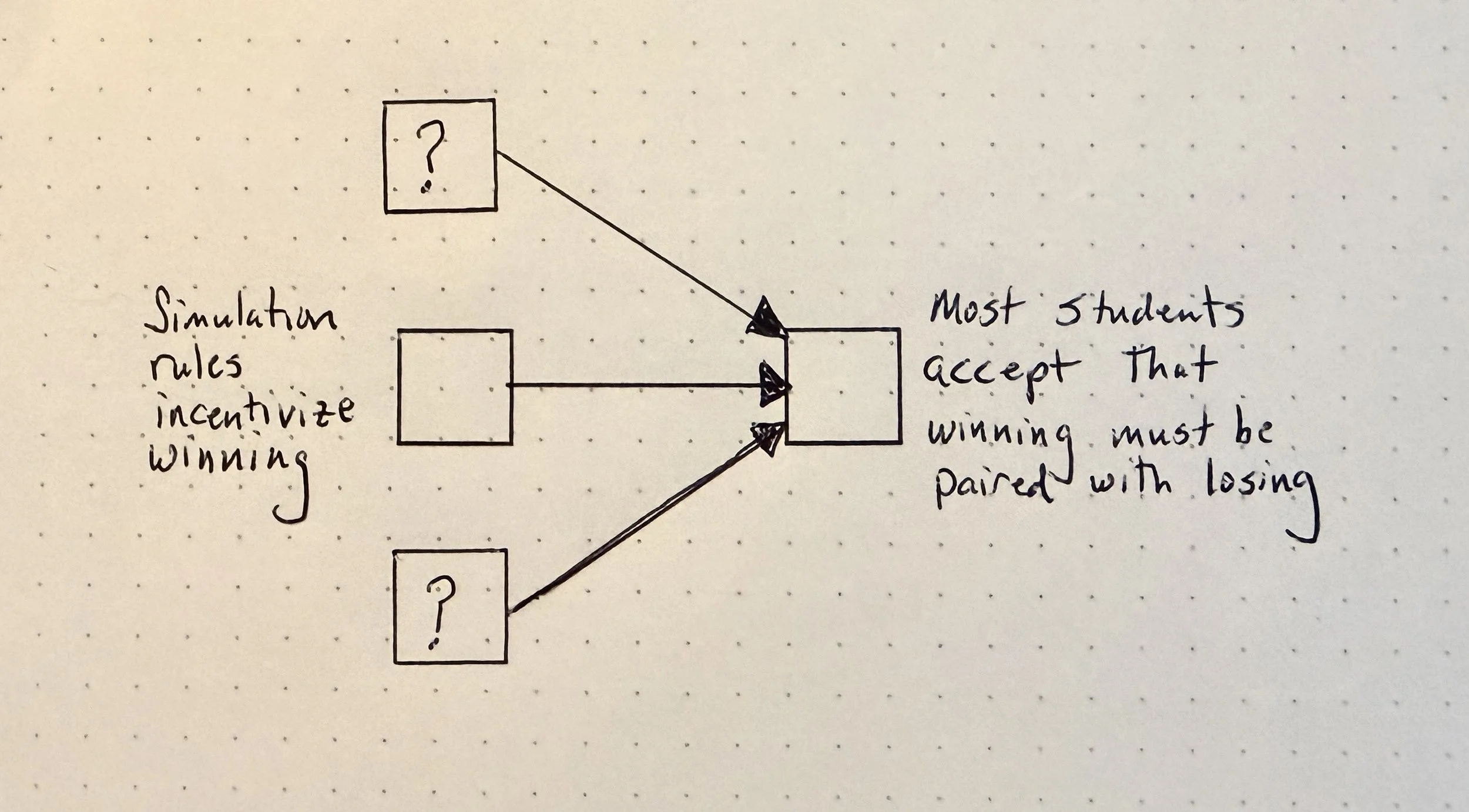
Map 1. I’ve added some unidentified actions acting on the reaction- most students accept that winning must be paired with losing.
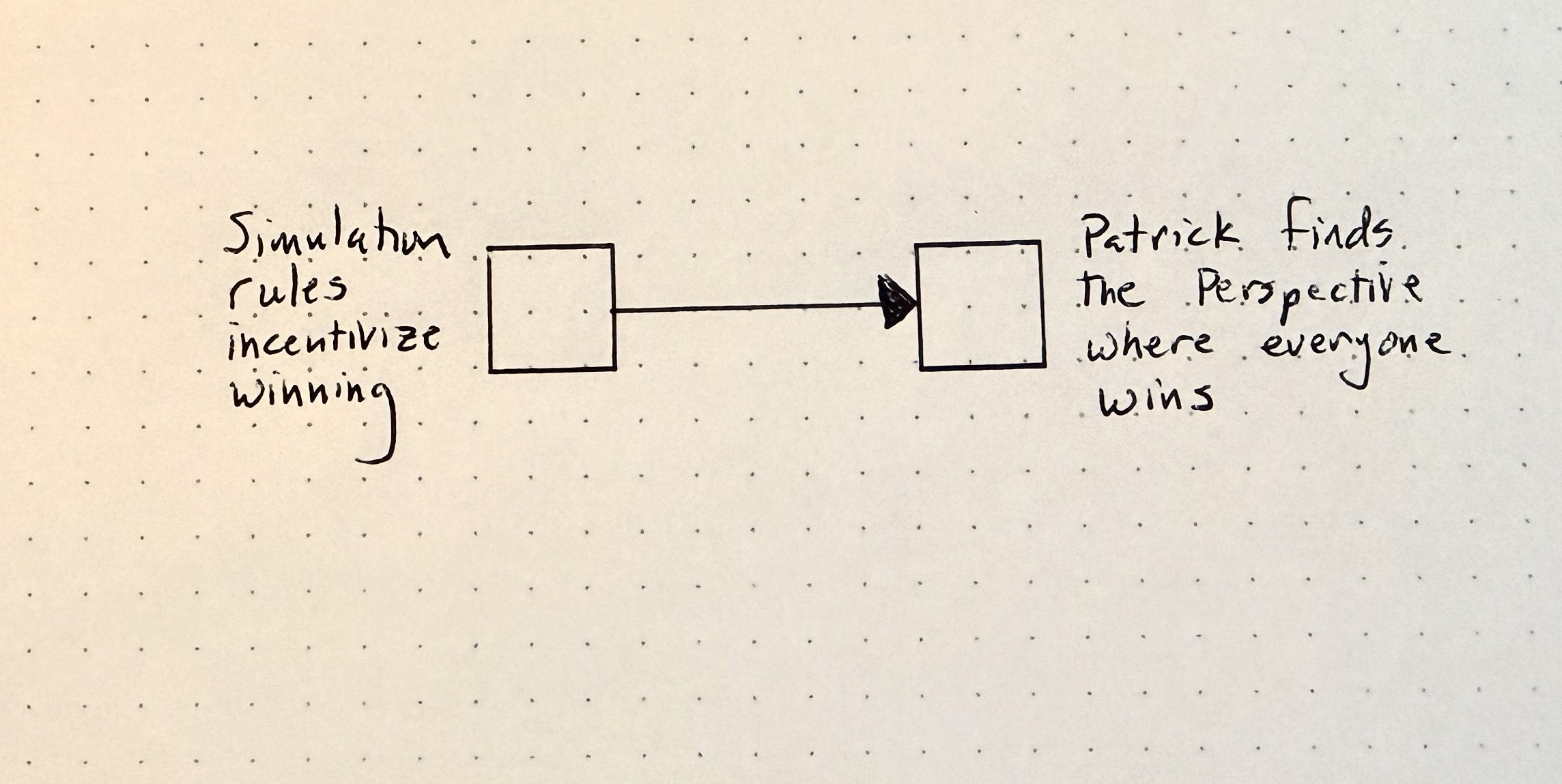
Map 2. I’ve left the unidentified actions out of this map, it seems Patrick was less affected by interacting with them.
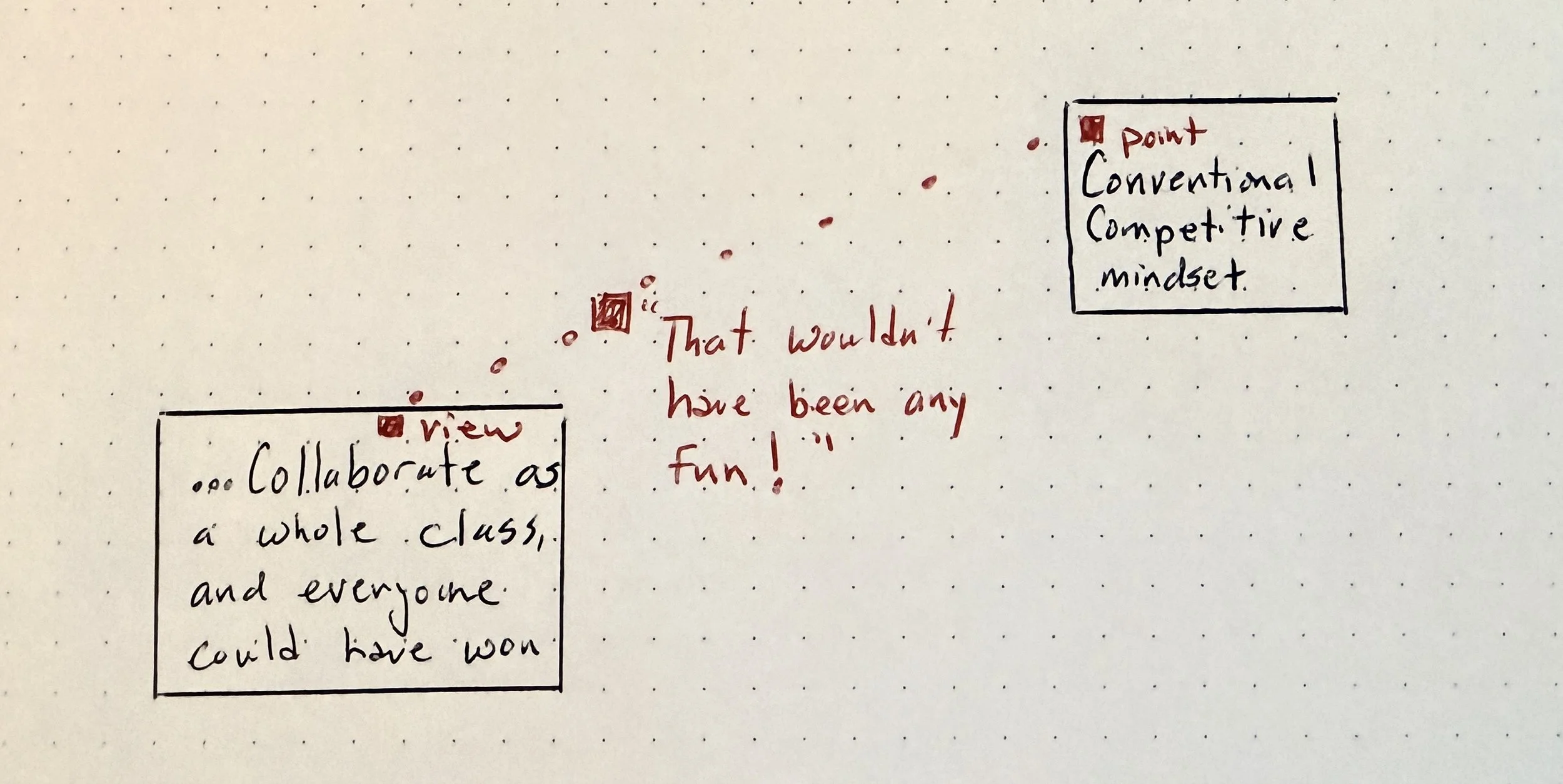
Map 3. The conventional competitive mindset is an implicit default (Perspective) point, that most people don’t notice. Even when Patrick made a clear case against it, this student impulsively shouted out in favor of the default point.
Some Updates Since
On Perspective-taking: I regularly talk to people about perspective taking as a skill. In these conversations people rarely get actively curious and consider zooming in on the parts of the skill or want to talk about why things look so differently from distinct perspectives. They also don’t regularly consider what happens at larger scales when human relationships play out with people unaware of the fundamentals of perspective as a skill. I know my experiences are a small sample set.
On competition/conflict as the point in a perspective: Many many environments prime people for competition as the status quo point to look at the world from…I’d argue surfacing this implicit perspective is critical for putting competition in its proper place.
I try to only use competition as the point I’m looking at things from when it fits. I’m not always successful at this, I have a lot of practice using it as an implicit point. Since I’ve been more aware of competition as the point in play in interactions, I generally find it predictable and uninspiring. You probably don’t want to invite me over for an evening of competitive board games if I’m tired.
Lastly, while I value simulations for learning (to supplement doing something real and meaningful), I’d never do another war simulation unless I was confident students would break it.
Rooting for ya!